
System Design: PACELC Theorem
PACELC Theorem
In practice, CAP Theorem or (PAC) from PACELC describes how when a Partition (P) occurs, we must choose between Availability (A) and Consistency (C).
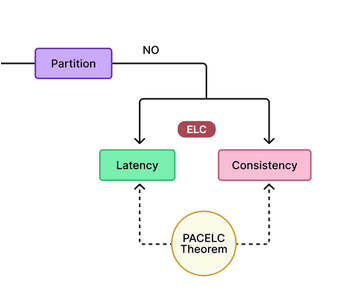
And PACELC provides tradeoffs when a system is under normal functioning or non partitioned.
Thus, (ELC) from (PACELC) describes while everything is functioning as Else/Expected (E), engineers must decide whether the system prioritizes Latency (L) or Consistency (C)
| Component | Meaning In Practice |
|---|---|
| Partition (P) | Network partition occurs |
| Availability (A) | System remains responsive |
| Consistency (C) | Data remains consistent |
| Else/Expected (E) | No partition, normal operation |
| Latency (L) | Low latency and fast response |
| Consistency (C) | Data remains consistent |
So CAP is limited to partition scenarios, while PACELC covers both partition and non partition scenarios.
| Aspect | CAP Theorem | PACELC Theorem |
|---|---|---|
| Focus Areas | Behavior during partitions | Behavior during partitions and normal operations |
| Trade off | System remains responsive | Availability vs Consistency and Latency vs Consistency |
| Practical Use | Theoretical foundation | Real world System Design |
Dealing With Expected Systems
| Priority Chosen | System Behavior | Impact |
|---|---|---|
| Latency (L) | Waits for coordinated updates | Higher latency |
| Consistency (C) | Responds immediately | Possible stale data |
Else/Expected, Latency, Strong and Eventual Consistency
Else/Expected
Ideally, a system spends most of its time in normal system operations. During this time you still need to decide between maintaining strong consistency or reducing latency to improve performance.
Latency (L)
In real world applications, latency directly affects how users perceive your systems. Even a small delay in response time can lead to a noticeable drop in user satisfaction, especially for interactive applications.
Strong, Eventual, and Hybrid Consistency (C)
In practice, most systems use a combination of consistency models, rather than relying on a single approach. Critical operations use strong consistency, while less critical ones use eventual consistency.
This selective approach allows you to balance performance and correctness effectively.
| Consistency Level | Behavior | Trade off |
|---|---|---|
| Strong | Immediate correctness | Higher latency |
| Eventual | Delayed convergence | Temporary inconsistency |
| Hybrid | Mixed guarantees | Increased complexity |
Strong Consistency
To achieve achieve a strong consistency, systems often require coordination between nodes, which introduces additional delays. This creates a tension between delivering fast responses and ensuring perfectly consistent data.
Eventual Consistency
Eventual consistency allows systems to relax strict guarantees and focus on performance. While data may be temporarily inconsistent, it eventually converges to a consistent state.
This model is widely used in large scale systems because it allows them to handle high traffic and maintain low latency. It represents a practical compromise between correctness and performance.
Hybrid
Modern systems often use hybrid architectures that combine multiple strategies to balance latency, consistency, and availability.
For example a system might use strong consistency for financial transactions and eventual consistency for user generated content.
This layered approach allows you to optimize each component individually rather than applying a one size fits all solution
| System Component | PACELC Preference | Reason |
|---|---|---|
| Payment Processing | Consistency (CP + EC) | Requires accuracy |
| User Feed | Latency (EL) | Prioritizes speed |
| Analytics Systems | Latency (EL) | Can tolerate delays |
| Inventory Management | Consistency (CP) | Prevents errors |